AI ERP & CRM · Owned solution · 7 min read
SIIMS
A manufacturing ERP MVP connecting customer orders, machine planning, production output, warehouse fulfillment, dispatch, and a read-only factory AI assistant.
Orders, production, warehouse, and dispatch on the same records
Project overview
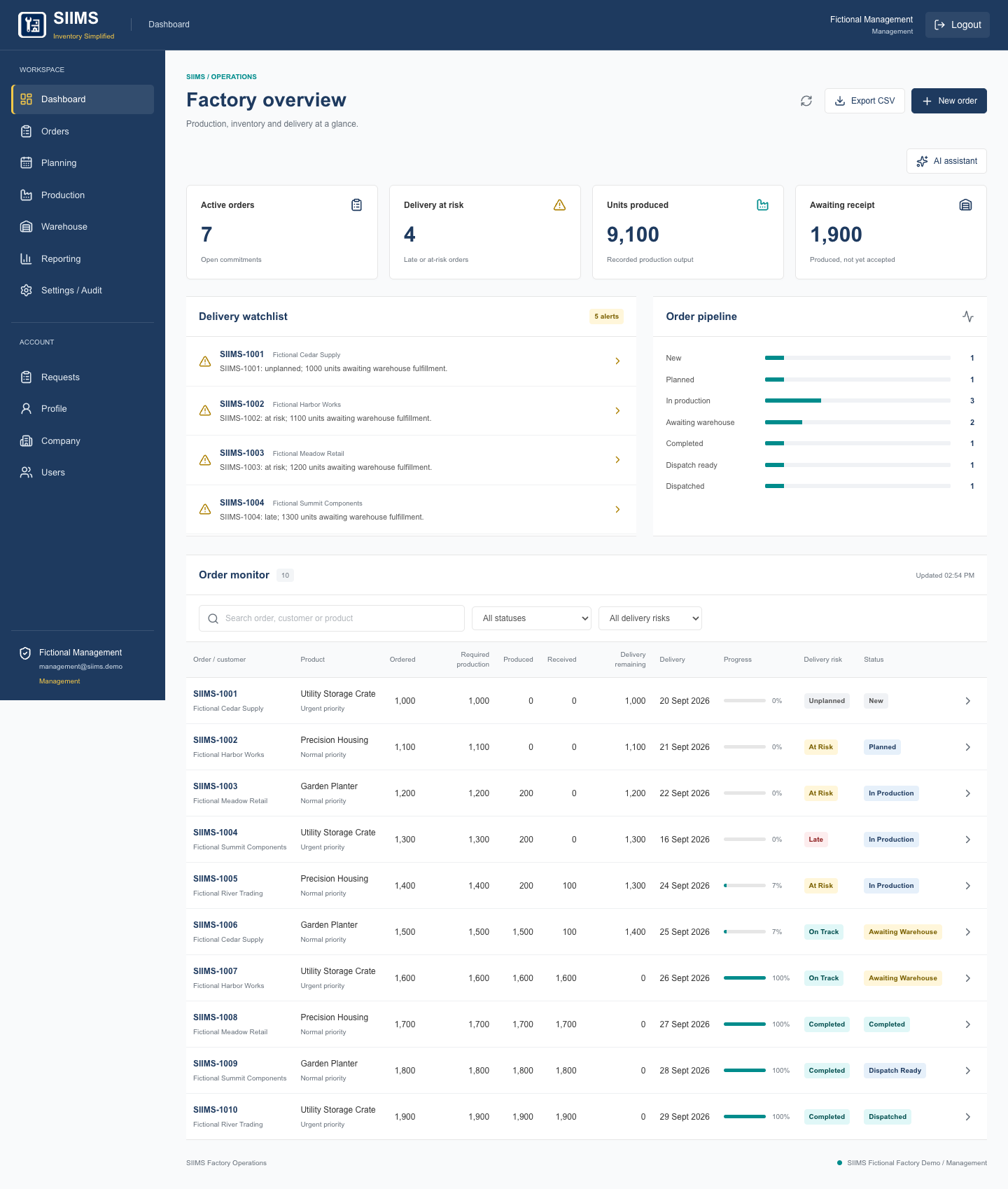
Customer orders carried through planning, production, warehouse receipt, and dispatch
Services: AI ERP & CRM ; AI Workflow Automation
Delivery: AIOVIX-owned manufacturing operations application, extended into a deployed, interactive ERP MVP with a factory-data AI assistant.
SIIMS gives administration, production, warehouse, and management teams a shared record of each customer order. It connects the requested quantity and delivery date to machine assignments, recorded output, stock allocation, warehouse receipts, and dispatch status.
The AI layer works on those operational records. A manager can ask which orders need attention or what remains outstanding, then open the referenced order to inspect it. The assistant helps with review; it does not take control of production or alter stock.
The Operational Problem
A customer order is not finished when production ends. Some quantities may already be available in stock. Others still need a machine assignment, production entry, or warehouse receipt. Dispatch has its own handoff after fulfillment.
When those stages are tracked separately, a team can mistake planned work for completed work, production output for warehouse stock, or an allocated quantity for a dispatched quantity. A manager has to reconstruct the order from several departmental updates before deciding what needs attention.
SIIMS was built around that distinction: keep each stage visible, but carry the same order record through the entire workflow.
What We Delivered
We extended the existing SIIMS application into a functional, authenticated manufacturing MVP while retaining its name and visual identity. The release includes:
- Factory dashboard: active orders, produced units, pending receipts, delivery-risk indicators, and an order watchlist.
- Customer orders: creation, editing, search, status and risk filters, order-detail views, and CSV exports.
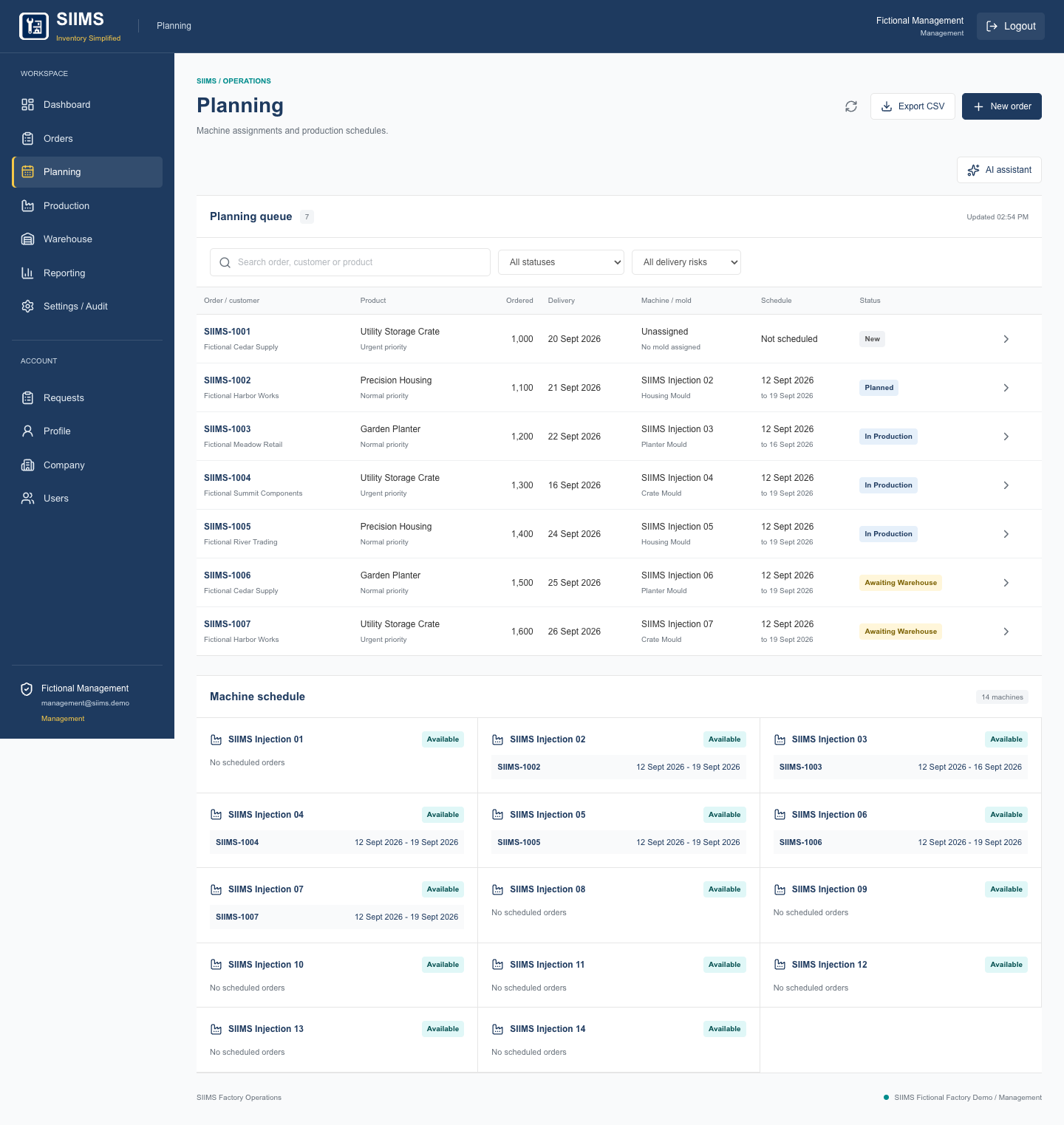
- Production planning: machine and compatible-mold assignments, dates, priority, material availability checks, and a machine schedule.
- Production tracking: partial output entries with machine, staff, time, notes, and remaining-quantity tracking.
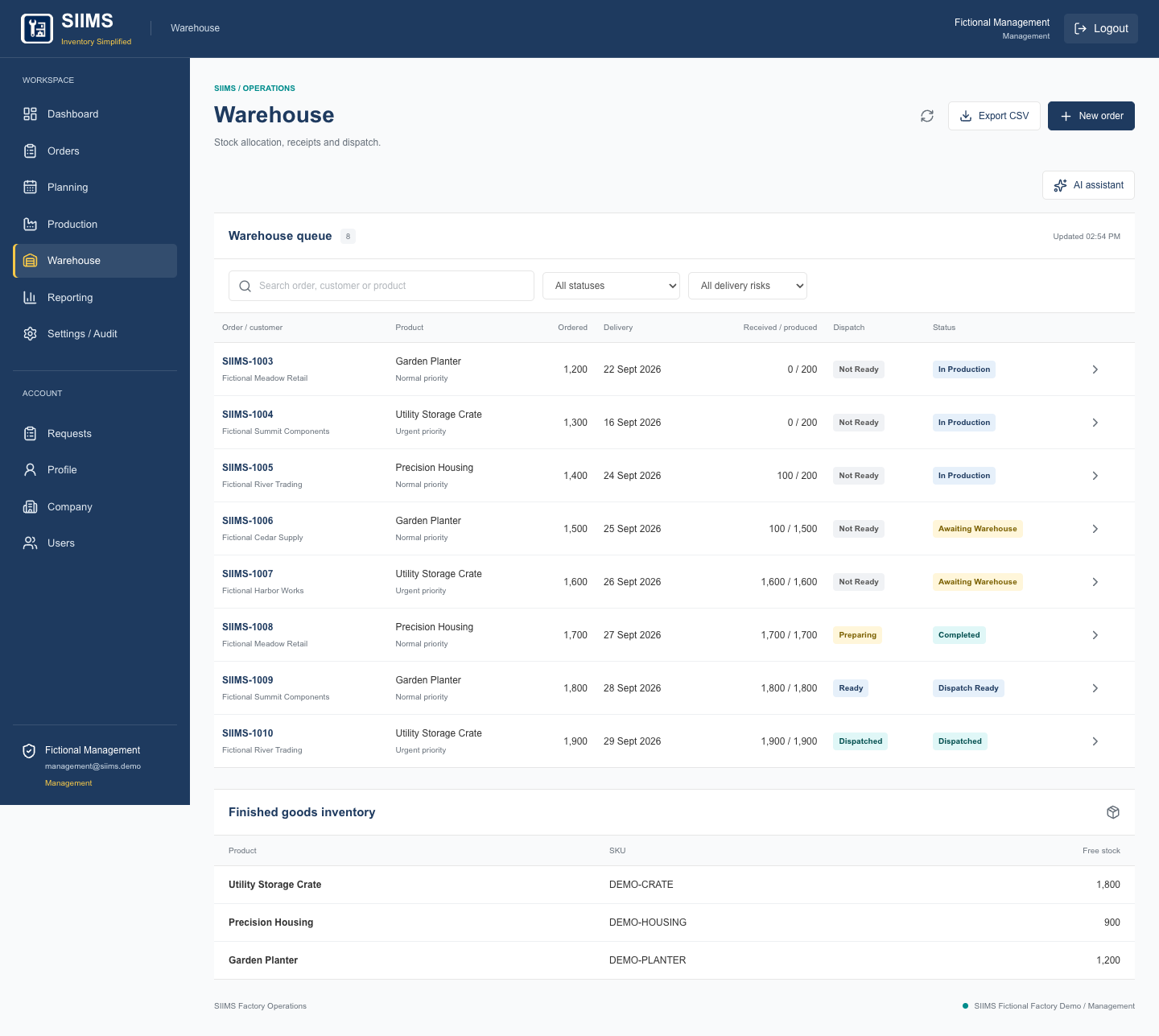
- Warehouse operations: finished-stock allocation, partial production receipts, fulfillment checks, and available inventory.
- Dispatch: preparing, ready, and dispatched stages attached to the order.
- Reporting: produced, received, and remaining quantities, order status, delivery risk, exports, and activity history.
- Workspace administration: company details, role-based staff access, invitations, profile editing, password changes, and member removal.
- Public pages and inquiries: product information, demo access, support, contact requests, and a management review queue.
- AI and email workflows: a read-only factory assistant, staff onboarding, account recovery, and persisted email retry handling.
The Order-to-Dispatch Workflow
- Capture the customer commitment. Administration records the product, quantity, urgency, and delivery date.
- Check what is available. The team reviews finished stock and raw materials before assigning new production.
- Plan the outstanding work. A machine, compatible mold, start date, end date, and priority are assigned to the order.
- Record actual output. Production staff log completed quantities as work progresses, including partial output.
- Receive and fulfill. Warehouse staff receive the produced goods or allocate existing finished stock. Fulfillment is checked against the requested quantity.
- Complete the handoff. The team moves dispatch through preparing, ready, and dispatched, while management reviews the order's progress and activity.
The application rejects conflicting machine schedules, invalid planning dates, receipts above recorded production, and order completion before fulfillment. These checks run in the backend, not only in the interface.
The AI Operating Layer
The factory assistant receives a fresh, sanitized snapshot of orders, stock, machines, plans, and summary metrics. It uses that context to answer operational questions rather than asking the user to paste records into a separate chat.
Example questions include:
- Which orders need attention before their delivery date?
- What remains outstanding for a particular order?
- Which machines are assigned to the current production plans?
Answers include validated order references that open the corresponding order details. The response also carries an as-of timestamp so the user can distinguish a generated answer from a later operational update.
OpenRouter provides the primary model connection, with OpenAI configured as a fallback. Provider credentials stay on the server. Per-account limits bound usage, and loading, failure, retry, and cancellation states are handled in the interface.
The assistant cannot execute arbitrary SQL, change orders, allocate stock, or send messages. Delivery-risk indicators are deterministic calculations based on configured rules, not predictive AI. Free-form notes and account credentials are excluded from the model context.
Team Access and Accountability
The MVP separates four operational roles while allowing workspace members to view factory records:
| Role | Operational responsibility |
|---|---|
| Management | All factory operations; the workspace owner also controls company details, staff, inquiries, and email-delivery review. |
| Administration | Customer orders, availability checks, planning, fulfillment completion, and dispatch. |
| Production | Production entries and operational visibility. |
| Warehouse | Stock allocation, production receipts, dispatch, and operational visibility. |
Staff sign in with password-authenticated sessions. Passwords are hashed; session cookies are protected; write requests are checked for CSRF. Changing a password revokes existing sessions, and removing a member revokes workspace access.
Staff invitations and recovery links use expiring, single-use tokens. Shared fictional demo accounts remain separate from real staff account-recovery workflows.
Engineering Decisions
Keep planned, produced, received, and dispatched work separate. Each represents a different business event. Combining them into one progress field would hide outstanding handoffs.
Enforce operational checks at the write boundary. Schedule conflicts, quantity limits, permissions, and fulfillment requirements are checked by the backend, including when a request bypasses the visible UI.
Reuse the operating record for AI review. The assistant reads bounded application data and points back to orders. It does not create a second source of operational truth.
Persist the workflow outside the frontend deployment. Vercel hosts the application; Cloud Run serves the backend; a dedicated Cloud SQL PostgreSQL database retains the hosted workspace state. Persistence was verified after a backend revision replacement.
Preserve inquiries when email fails. Contact requests are saved independently of provider delivery. Email jobs remain in a persisted outbox for scheduled retry and owner review, rather than making the business record depend on an email service response.
Verification and Results
The delivered MVP connects order capture, machine planning, production, warehouse fulfillment, dispatch, reporting, and AI review in a working application.
Dated verification on September 17, 2026 includes:
- 37 passing backend tests covering operational checks, permissions, persistence, AI access and non-mutation, invitation and recovery tokens, and email failure/retry handling.
- 17 passing hosted functional browser tests covering the order-to-dispatch workflow, staff access, session revocation, saved company/profile changes, exports, inquiries, and role restrictions.
- A live AI-provider check that compared an answer and its referenced order against current fictional factory records.
- Desktop and mobile visual checks across public, operational, and account-management pages.
- Hosted persistence verification after replacing a Cloud Run backend revision.
These are implementation and verification results. The demo uses fictional factory records; it is not evidence of client production throughput, staff adoption, reduced lead times, or financial savings.
Email onboarding, recovery, acknowledgment, and retry workflows are implemented. Sending-domain verification remains an external requirement before inbox delivery can be established.
Technology Stack
| Layer | Implementation |
|---|---|
| Interface | Next.js, React, Tailwind CSS, Lucide icons |
| Backend | Node.js, Express, server-side validation and role checks |
| Data | Cloud SQL PostgreSQL for hosted persistence; SQLite for local development |
| AI | OpenRouter, OpenAI fallback, structured responses, sanitized factory snapshots |
| Resend, persisted delivery outbox, scheduled retry | |
| Hosting | Vercel frontend, Google Cloud Run backend |
| Infrastructure | Google Secret Manager, Cloud Scheduler with authenticated invocation |
| Verification | Node test runner, Playwright, desktop/mobile screenshots |
The current MVP persists a transactional single-workspace snapshot. It is not presented as a normalized, multi-factory ERP implementation. A production rollout would require real master data, unique staff accounts, normalized tables and migrations, and deployment hardening appropriate to the customer's environment.
Demo and Release Boundaries
Explore the SIIMS application guide or open the interactive demo.
The public demo lets reviewers compare management, administration, production, and warehouse views using fictional records. Billing, hardware or sensor integrations, WhatsApp messaging, and offline synchronization are not enabled. Operational decisions and writes remain controlled by the team.
Project at a glance
Manufacturing orders connected from planning through dispatch.
SIIMS combines customer orders, machine planning, production entries, warehouse fulfillment, dispatch, and a read-only AI assistant in a deployed manufacturing ERP MVP.
Project summary
We built SIIMS around the handoffs between administration, production, and warehouse teams. Every stage refers to the same customer order, with backend checks for schedules, quantities, and fulfillment. Its AI assistant helps managers inspect current factory records without giving a model control over stock or production.
Build a system around your workflow.
Tell us where the work gets stuck. We will map the first release, integrations, cost, and timeline.
Discuss a similar project