
Risk and screening
Twelve searches become one case a person can defend.
Replace disconnected searches and manual report preparation with source-linked screening cases, analyst-reviewed AI findings and structured reports.
Built for: Screening, compliance and investigation teams
A short call about one operation. No obligation.
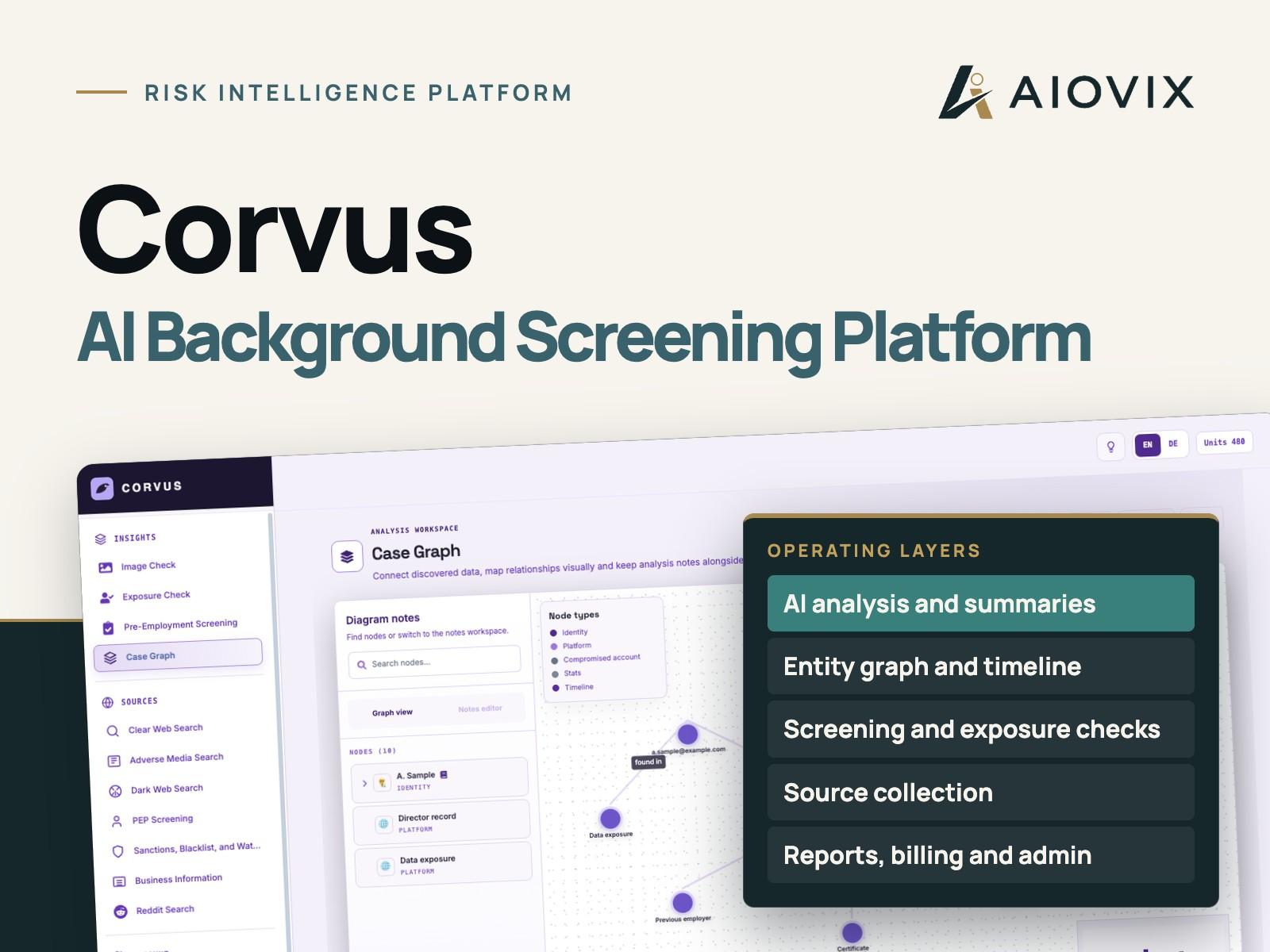
The name and branding are changed. The screen shown has made-up data.
Bring complex background screening into one defensible investigation workflow.
Before
With Corvus
- Before: Searching each source separatelyAfter: One workspace runs the searches the check requires
- Before: Connections held in the analyst’s headAfter: A case graph shows how every finding links
- Before: Reports written from memoryAfter: Reports downloaded from the platform
- Before: Hard to show where a fact came fromAfter: Links and notes recorded on the case graph
Project scale and operating metrics.
The screening process and its supporting evidence are managed in one place instead of separate searches and follow-ups.
- organisations
- 18
- users
- 75
- candidate cases
- 3,200
- checks across five categories
- 12,800
- Research per caseBefore: 4–6 hoursAfter: 45–75 minutes
- Report assemblyBefore: 45 minutesAfter: 8–12 minutes
Delivery team and timeline: 3 engineers, about 6 to 8 months.
The operating loop: Unify. Model. Command. Verify.
Automation runs a task. We engineer the infrastructure an organization runs on: it understands the operation, governs who can act, and proves what happened.
Unify
Bring identity, employment, company, sanctions, adverse-media and exposure findings into one investigation case.
Model
Model people, organisations and evidence as connected entities.
Command
Command purpose-specific searches, analyst workflows and access.
Verify
Verify findings against their sources before a human decision.
The problem with checking a person or a company.
A background check is rarely one search. It is the public web, news coverage, data exposures, politically exposed person and sanctions lists, company records and community sites. Each answers a narrow question, in its own format, with its own idea of what a match is.
The difficult part is not finding a fact. It is knowing how that fact relates to the others, whether two records describe the same person, and being able to show where each point came from. Done across browser tabs and a document, the analyst holds the connections in their head, and the report depends on what they remember.
What we built, and why each part was hard.
1Searches across many sources
What it does
Clear web, adverse media, dark web, politically exposed person, sanctions, business information and community searches run from one workspace.
Why it was hard
The sources do not agree on anything: not on inputs, not on what comes back and not on how long they take. A search by email, phone number, name or username has to become one consistent experience without pretending the answers are equally reliable.
2A case graph
What it does
People, addresses, companies, usernames and findings appear as connected points that can be arranged, labelled and annotated.
Why it was hard
A list hides relationships and an unfiltered graph buries them. The analyst needs to add what matters, arrange it and note why a link exists. The graph is saved in the analyst's browser and can be exported and imported.
3AI analysis
What it does
AI reads resumes, extracts names and entities and writes risk summaries.
Why it was hard
A summary about a person can affect their job. It can only be a starting point: something that tells a reviewer where to look, which they then check against the source.
4Screening modules
What it does
Image checks, exposure checks and pre-employment screening sit alongside the individual searches.
Why it was hard
Different customers are entitled to different checks, and some checks should not be run for some purposes. Access to each module is controlled per account instead of everything being open to everyone.
5Reports, billing and administration
What it does
Results are downloaded as reports. Usage is paid for in units, with search history and an admin console.
Why it was hard
Checks cost money each time they run, and a batch of them can partly fail. Batches are reconciled so a failed check is recorded as failed rather than silently counted as a result.
How it is built to be trusted.
- The platform gathers and organises; a person decides. It does not make the hiring or business decision.
- Exposure results can contain leaked passwords. These are masked, so an analyst learns that a credential was exposed without being handed the credential.
- Users are told to run only the checks their screening purpose requires, and module access is set per account.
- Search history can be reviewed and deleted.
Where it gets difficult.
The same name, a different person
Common names produce confident-looking matches. A match is a lead to verify, and the case graph is where the analyst records why two things are, or are not, connected.
Secrets inside the results
Data from exposures can include passwords. Showing them would turn a screening tool into a risk of its own, so they are masked.
A batch that half succeeds
When many checks run together, some can fail. Each one carries its own status, so an incomplete batch does not read as a clean one.
More checking than the purpose needs
Having a source available is not a reason to use it. Entitlements and an explicit compliance notice keep the scope of a check deliberate.
Everything in the system.
Screening cases
- One case per candidate with five checks: CV, documents, identity, image, reference
- Candidate completes the identity check through a link
- Past employers answer reference requests through a link
- A report for each check
- Bulk background checks
Intelligence sources
- Web search
- Adverse media
- Dark web exposure checks
- Politically exposed persons, sanctions and watchlists, international police notices
- Company records from national registers across multiple jurisdictions
- Community source research
- Email scan for trade embargoes
Analysis and investigation
- AI resume analysis and risk summaries
- Document and image authenticity checks
- Case graph with notes, export and import
- Assistant chat
- Search history
Running it as a business
- Company accounts and users, module access per account
- Pay-per-use units, subscriptions and invoices
- Data agreement and terms acceptance
- Two languages
- Admin and health monitoring
- Leaked passwords are masked in results
How a case moves through it
- 1The analyst opens a case for a person or company.
- 2They run the searches that the purpose of the check requires.
- 3Findings are added to the case graph and linked.
- 4AI summarises documents and highlights points that need review.
- 5The analyst checks each point against its source and records notes.
- 6A report is downloaded for the person who makes the decision.
Questions buyers ask.
Does the platform decide whether someone passes?
No. It collects findings, shows how they connect and summarises what may need attention. A person reviews the sources and makes the decision. Automating the verdict would be faster and much harder to defend, to the organisation and to the person being checked.
How do you handle leaked passwords that turn up in a search?
They are masked. The useful fact for a screening or security team is that a credential tied to an address was exposed, and where. The password itself adds risk and no insight.
Where is the case graph kept?
In the analyst's browser, with export and import for moving or keeping it. That limits what sits on a server, and the trade-off is that sharing a graph with a colleague means exporting it. A team that needs shared, server-side cases would be a further build.
Want this for your team?
Talk to AIOVIX about secure screening and compliance platforms.
Book a short call and show us the operation. You leave knowing what we would take on first and what should stay manual.
Book an Operations AuditThis fits you if
- Your team checks people or companies across many separate sources
- You need to show how each finding connects to a case
- A person has to make the final call