Planroom, Construction
Bid packages turned into answers with the source page attached
A construction-document workflow built for structured extraction and project-scoped retrieval.
Built for: Construction estimating and preconstruction team
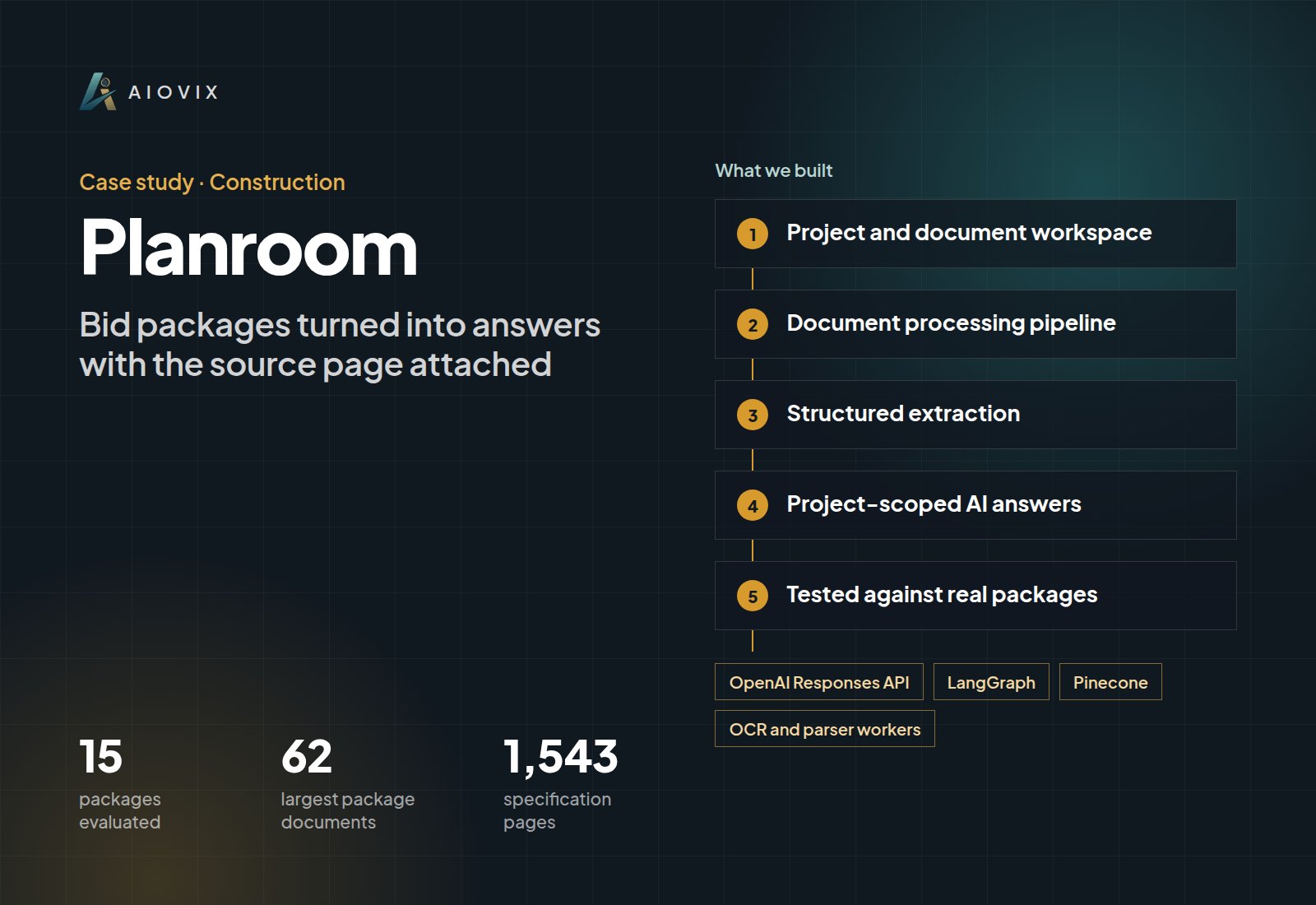
- packages evaluated
- 15
- packages evaluated
- largest package documents
- 62
- largest package documents
- specification pages
- 1,543
- specification pages
- packs reviewed in depth
- 10
- packs reviewed in depth
First agent live in one week. A short call. Your first agent, a fixed quote, and the timeline. No obligation.
Sound familiar?
- “We nearly missed a bid deadline because it was buried in an addendum.”
- “A thousand-page spec means days of reading before we can even start pricing.”
- “AI tools give us answers, but we cannot see which page they came from.”
How the system works.
- Step 1
Project and document workspace
Projects, documents, permissions, and team assignments organized per bid.
- Step 2
Document processing pipeline
OCR and parser workers extract content from PDFs, office files, emails, screenshots, and plan sets, then chunk and summarize it.
- Step 3
Structured extraction
Scope, quantities, schedule, compliance, cost, and risk pulled into defined fields, with evidence records linking back to the source.
- Step 4
Project-scoped AI answers
A LangGraph worker separates tool calls, retrieval review, and reasoning before answering, using Pinecone retrieval and the OpenAI Responses API.
- Step 5
Tested against real packages
Outputs were checked field by field against the original documents, not accepted because they read well.
What changed.
- 15 real construction bid packages evaluated
- A 62-document package with a 1,543-page specification processed
- 10 output packs compared field by field against the source documents
- Every answer traceable to the page it came from
The AI inside.
OpenAI Responses API
Answers project questions and produces structured extraction from bid documents
LangGraph
Runs the agent flow that separates tool calls, retrieval review, and reasoning
Pinecone
Stores document embeddings so answers retrieve the right source passages
OCR and parser workers
Read scanned and digital construction documents into text the system can use
The full stack.
Frontend
- React
- Next.js
Backend
- Node.js
- Express
- TypeScript
- Python
Data
- PostgreSQL
- S3
- Pinecone
AI and automation
- OpenAI Responses API
- LangGraph
- Embedding services
- OCR and parser workers
Infrastructure
- Pipeline checkpoints
- Error records
- Telemetry
This fits you if...
- Your estimators spend days reading specs before pricing starts
- Missing one deadline or requirement in a bid pack costs you the job
- You need AI answers you can check against the source page
Start with a free Agent Audit. First agent live in one week
The Document Intake Agent brings this to your team.
Every contract, invoice, and bid pack becomes a checked record, with the source page attached.
Full project write-upRead itClose
Project overview
Construction-document analysis tested against real bid packages
Services: Document AI ; RAG Knowledge Systems ; AI Agents ; AI Workflow Automation
Delivery: Document processing, structured extraction, and project-scoped retrieval. Portfolio alias.
Project Snapshot
| Figure | What it represents |
|---|---|
| 15 construction packages | Dataset in the March 27 extraction-quality review |
| 62 documents | Largest package described in that review |
| 1,543 pages | Specification within that package |
| 10 output packs | Extraction outputs examined in the review |
These figures describe evaluation scope, not perfect extraction or production throughput.
The Problem
Bid information can be scattered across an invitation email, a drawing title block, a specification, and an addendum. The team needs more than a summary. It needs the deadline, scope, exclusions, compliance obligations, and the source behind each item.
Large documents made the problem harder. A field could be extracted somewhere in the output but fail to appear in the field the user needed. The March review found examples where a bid date existed in an entries list but was absent from the headline bid-due field.
That is a product correctness problem, even when the underlying text was read successfully.
What We Delivered
The platform organizes projects, documents, permissions, and team assignments. Processing services extract content, produce chunks and summaries, and build retrieval indexes. Evidence records preserve the connection to source material.
A project-scoped question endpoint passes tenant and project context to a Python retrieval worker. Its LangGraph flow separates tool calls, retrieval review, and further reasoning before returning an answer.
Structured extraction covers scope, quantities, schedule, compliance, cost, risk, and related project information. The ten-pack review compared outputs with the original documents rather than accepting fluent text as sufficient evidence.
What Testing Revealed
The review covered PDFs, office files, emails, screenshots, and plan sets. It reported strong project-identity capture, but also material gaps in deadlines, insurance, bonding, and risk outputs.
Those findings explain the need for field-level checks and source review. A result can look detailed while missing the one deadline that determines whether a contractor can submit a bid.
The case study does not claim that the historical gaps have all been eliminated. Current acceptance results are needed before attaching an accuracy percentage.
Results
The delivered system provides a project workspace, document-processing pipeline, structured outputs, retrieval, and evidence inspection. The available review establishes that it was exercised against fifteen real construction packages, including the large package described above.
The engineering record supports a tested document workflow. It does not support an error-free estimating claim.
Technology stack
React/Next.js; Node.js, Express, TypeScript; PostgreSQL and S3; OCR/parser workers; Pinecone and embedding services; Python, LangGraph, OpenAI Responses API; pipeline checkpoints, error records, and telemetry.
Related case studies.
Want this for your team?
Book a short audit call and show us the workflow. You leave with the first agent we would build, a fixed quote, and the timeline.