Ledgerline, Finance operations
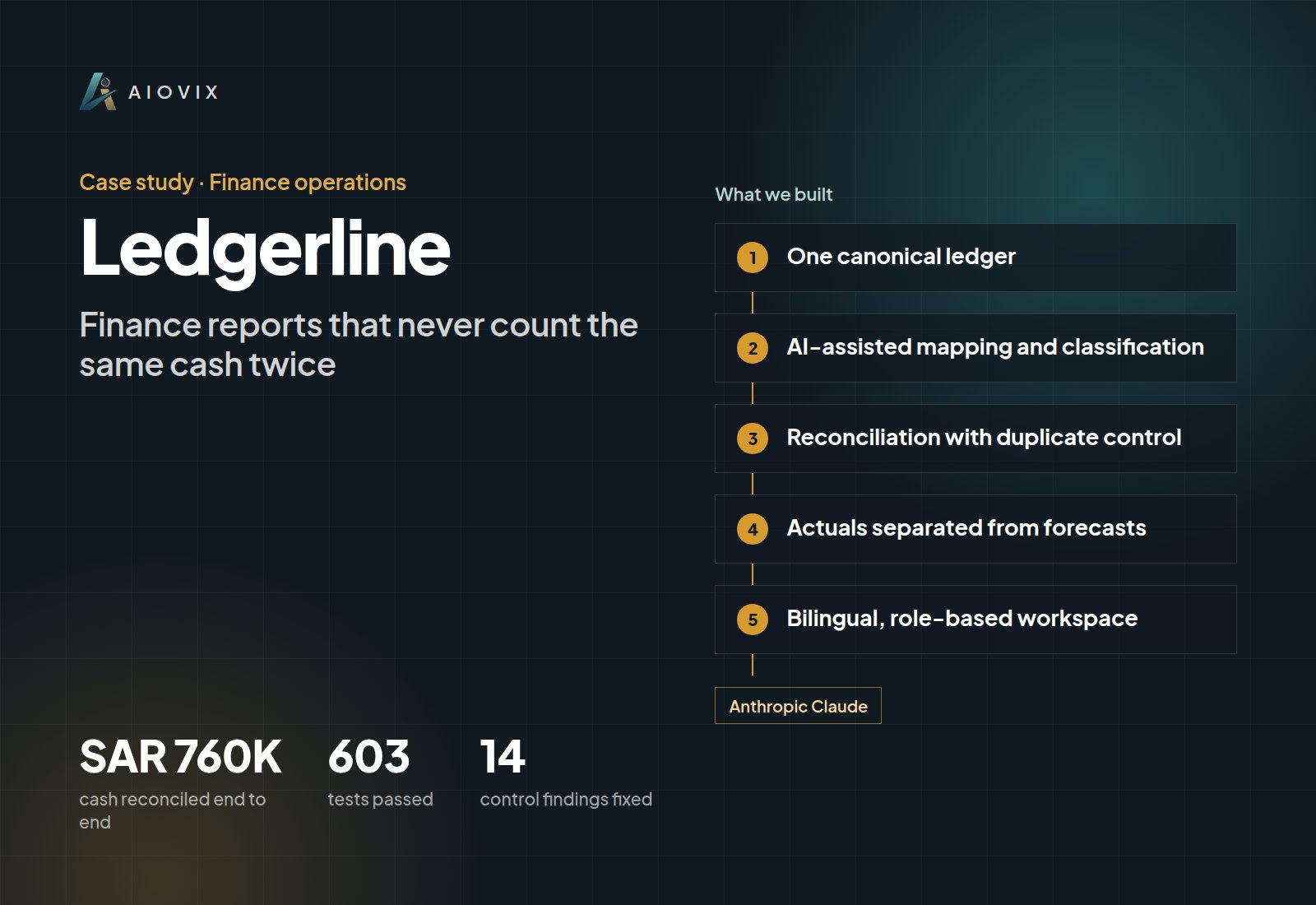
Finance reports that never count the same cash twice
A bilingual finance workspace designed to distinguish actual cash, expected cash, and source-system records.
Built for: Finance team running accounting, banking, and spreadsheet data
- cash reconciled end to end
- SAR 760K
- cash reconciled end to end
- tests passed
- 603
- tests passed
- control findings fixed
- 14
- control findings fixed
- finance sources in one ledger
- 3
- finance sources in one ledger
First agent live in one week. A short call. Your first agent, a fixed quote, and the timeline. No obligation.
Sound familiar?
- “The same payment shows up twice, once from the bank and once from the books.”
- “Our P&L shows money we have not received yet.”
- “Month-end means three spreadsheets and a week before anyone trusts a number.”
How the system works.
- Step 1
One canonical ledger
Qoyod, Zoho, Lean banking data, and file imports all feed a single ledger the team can review.
- Step 2
AI-assisted mapping and classification
Anthropic-based suggestions map accounts and classify bank movements using descriptions, merchant context, and approved history.
- Step 3
Reconciliation with duplicate control
One-to-one bank-to-books matching, with pending duplicates held for review instead of silently dropped.
- Step 4
Actuals separated from forecasts
Expected incoming and outgoing cash stay in the forecast, and P&L values are VAT-exclusive with reporting-currency rules.
- Step 5
Bilingual, role-based workspace
Arabic and English, with owner, administrator, and viewer roles and a finance audit trail.
What changed.
- 14 financial-control findings addressed
- 603 passing tests across 122 files
- SAR 760,000 cash position reconciled with SAR 73,600 incoming and SAR 73,775 outgoing kept as forecast
- Bank and accounting records no longer double count the same cash
The AI inside.
Anthropic Claude
Suggests account mappings and bank classifications for finance staff to review
The full stack.
Frontend
- Next.js 15
- React 19
- TypeScript
- Bilingual dictionaries
Backend
- Canonical ledger
- Deterministic reporting modules
- Role-based access
Data
- PostgreSQL
- ExcelJS imports
- Finance audit records
AI and automation
- Anthropic Claude
Integrations
- Qoyod
- Zoho
- Lean banking
This fits you if...
- Your bank feed and accounting system disagree every month
- Forecasts and actuals end up mixed in the same report
- You need AI help with classification but strict rules on the final numbers
Start with a free Agent Audit. First agent live in one week
The Finance Operations Agent brings this to your team.
Close the month in days and get paid on time.
Full project write-upRead itClose
Project overview
Financial reports that distinguish actual cash from expected cash
Services: AI Fintech ; AI Workflow Automation ; AI ERP & CRM
Delivery: Bilingual finance workspace with accounting integrations and AI-assisted review. Portfolio alias.
Project Snapshot
| Figure | What it represents |
|---|---|
| 14 findings | Financial-control issues addressed in the July 25 verification |
| 603 tests in 122 files | Passing suite recorded by that verification |
| 2 languages | Arabic and English |
| 3 user roles | Owner, administrator, and viewer in the documented product scope |
These are engineering and product figures. The verification used demonstration data, not a client's audited financial statements.
The Problem
Ledgerline brings accounting, bank, and imported spreadsheet records into one finance workspace. The difficult part is deciding what each number represents before adding it to a report.
An invoice amount can include VAT. A bank movement can duplicate the payment already recorded by an accounting system. An expected customer payment belongs in a forecast, not in actual revenue. Different currencies cannot be added as if they were the same unit.
These distinctions became the focus of a financial-control review covering dashboards, cash visibility, reconciliation, duplicate handling, VAT, Zakat, and consolidated reporting.
What We Delivered
The product connects Qoyod, Zoho, Lean banking data, and file imports to a canonical ledger. Users review transactions, mappings, duplicate candidates, and bank-to-books matches.
AI assists with account mapping, bank classification, and review tasks. It works from transaction descriptions, merchant context, categories, and approved tenant history. Dedicated calculation modules produce cash, cost, tax-estimate, and group views.
The remediation introduced explicit actual-versus-forecast treatment, VAT-exclusive P&L values, reporting-currency rules, and one-to-one reconciliation. Pending duplicate candidates no longer suppress records before acceptance. A matched bank copy is excluded when its accounting event is already counted.
A Concrete Verification Example
In the demonstration dataset, SAR 73,600 of expected incoming cash and SAR 73,775 of expected outgoing cash had to stay out of actual KPIs.
The corrected cash view retained them as forecasts:
- Cash available: SAR 760,000.
- Expected incoming: SAR 73,600.
- Expected outgoing: SAR 73,775.
- Projected closing cash: SAR 759,825.
That example shows the reporting behavior. It is not money saved or revenue earned by the client.
Results
The July 25 remediation record closes fourteen findings and records 603 passing tests, a successful production build, a database migration, and browser checks across the finance views.
Unsupported currencies are sent to review until a conversion policy is available. VAT and Zakat remain estimates requiring professional review before filing.
Technology stack
Next.js 15, React 19, TypeScript, PostgreSQL, ExcelJS; Qoyod, Zoho, Lean; Anthropic-based financial suggestions; canonical ledger and deterministic reporting modules; role-based access, bilingual dictionaries, AI-usage and finance-audit records.
Want this for your team?
Book a short audit call and show us the workflow. You leave with the first agent we would build, a fixed quote, and the timeline.