
Wealth and estate management
Who owns what should take seconds to answer, not an afternoon.
Connect estates, entities, people, assets and dated ownership relationships with documents and permissions.
Built for: Advisers and family offices managing structures
A short call about one operation. No obligation.
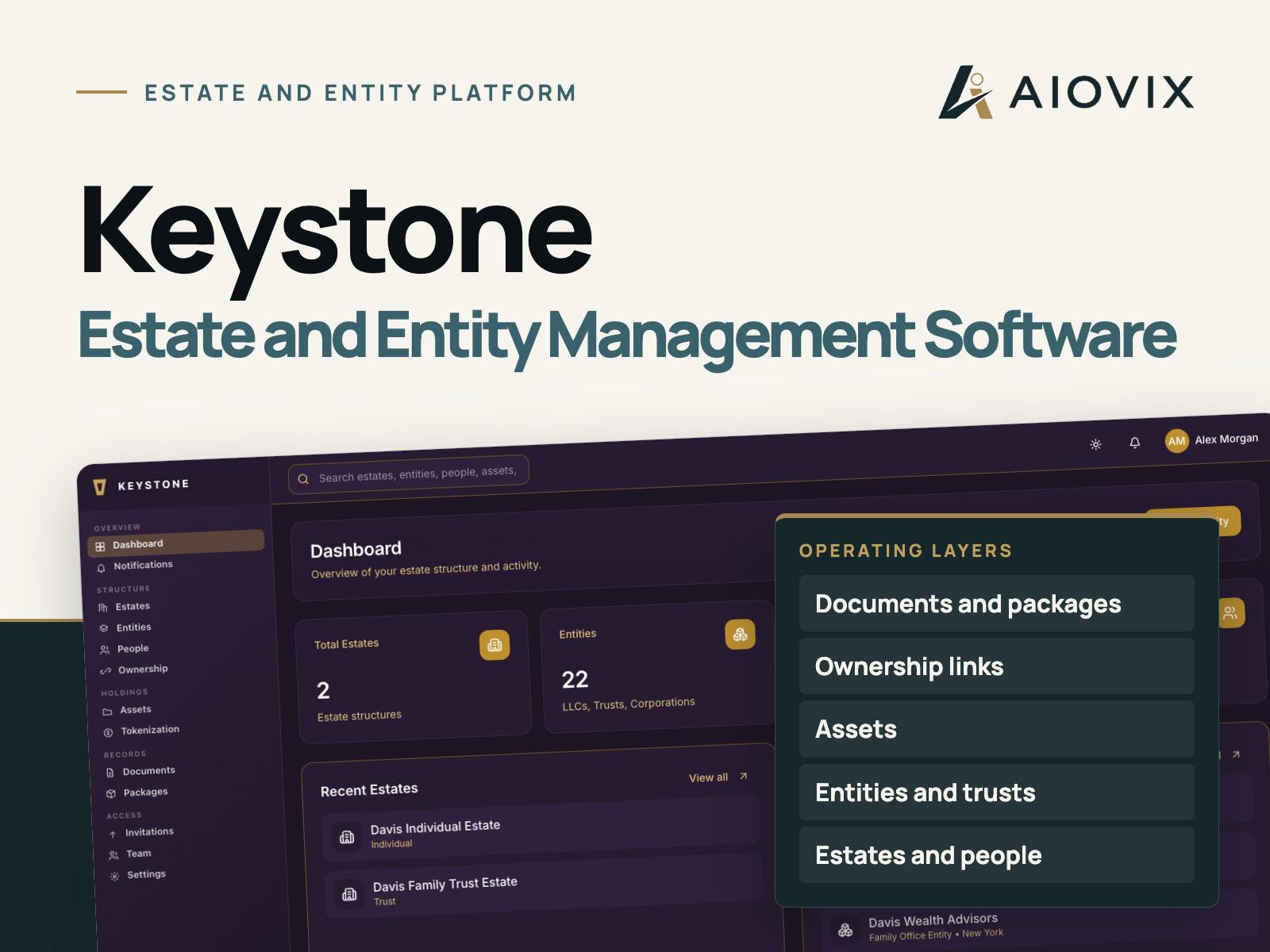
The name and branding are changed. The screen shown has made-up data.
Make complex ownership structures searchable, current and accountable.
Before
With Keystone
- Before: Structure charts out of dateAfter: Ownership held as dated, linked records
- Before: Facts spread across filesAfter: Estates, entities, people and assets in one place
- Before: Documents detached from entitiesAfter: Documents filed against what they describe
- Before: Access shared by sending filesAfter: Invited, role-based access
Project scale and operating metrics.
The ownership structure and the documents behind it are visible without rebuilding a chart from separate files.
- advisory and family office teams
- 7
- users
- 40
- entity, estate and person records
- 1,200
- ownership and asset links
- 3,500
- Ownership lookupBefore: 30–60 minutesAfter: 3–5 minutes
- Document retrievalBefore: 10–15 minutesAfter: 1–3 minutes
Delivery team and timeline: 3 developers, about 5 to 7 months.
The operating loop: Unify. Model. Command. Verify.
Automation runs a task. We engineer the infrastructure an organization runs on: it understands the operation, governs who can act, and proves what happened.
Unify
Unify estates, entities, people, assets and documents.
Model
Model ownership, relationships, roles and permissions.
Command
Command estate and entity workflows through controlled access.
Verify
Verify changes and records through reviewable data and document history.
The solution.
Keystone is built for advisers and family offices who look after structures made of estates, trusts, companies, people and assets.
Keystone keeps estates, entities, people and assets as connected records. Ownership links carry the percentage, role and start date, so the structure is data rather than a drawing. Assets are tracked with type, value and owner. Documents are organised by category and gathered into packages, and colleagues are invited with role-based access.
The challenge.
Previously, ownership information was scattered across spreadsheets, legal documents, folders and static structure charts that became outdated.
- Nobody can say quickly who owns what.
- The structure chart is out of date the day it is drawn.
- Documents are not tied to the entity they describe.
Everything in the system.
Structure
- Estates and estate members
- Entities, people
- Ownership links with percentage, role, date
- Tree, folder and list views
Holdings
- Assets with type and value
Records
- Documents by category
- Packages
- Search
- Suggestions and review decisions
Access
- Invitations, team, workspaces, notifications
- Two-step sign-in
The engineering challenge.
The hardest part was modelling ownership as dated relationships rather than a static diagram, while keeping documents and access permissions tied to the right records. The strongest achievement is a structured estate/entity model with ownership percentages, roles, dates, asset records and controlled collaboration.
How a structure is built up
- 1Create the estate and the entities within it.
- 2Add the people involved and their roles.
- 3Record ownership links with percentage and date.
- 4Attach assets to the entity or person that holds them.
- 5File documents and assemble them into packages.
- 6Invite the people who need access.
What keeps it dependable
- Each organisation sees only its own records.
- Ownership is held as dated links, so changes can be followed.
- Access is granted by invitation and role.
- Documents stay tied to the records they describe.
Want this for your team?
Explore estate and entity management software.
Book a short call and show us the operation. You leave knowing what we would take on first and what should stay manual.
Book an Operations AuditThis fits you if
- You manage structures with many entities
- Ownership questions take days to answer
- Documents and records drift apart