Connexions Recovery, Healthcare admissions
Every admissions call becomes a record staff can act on
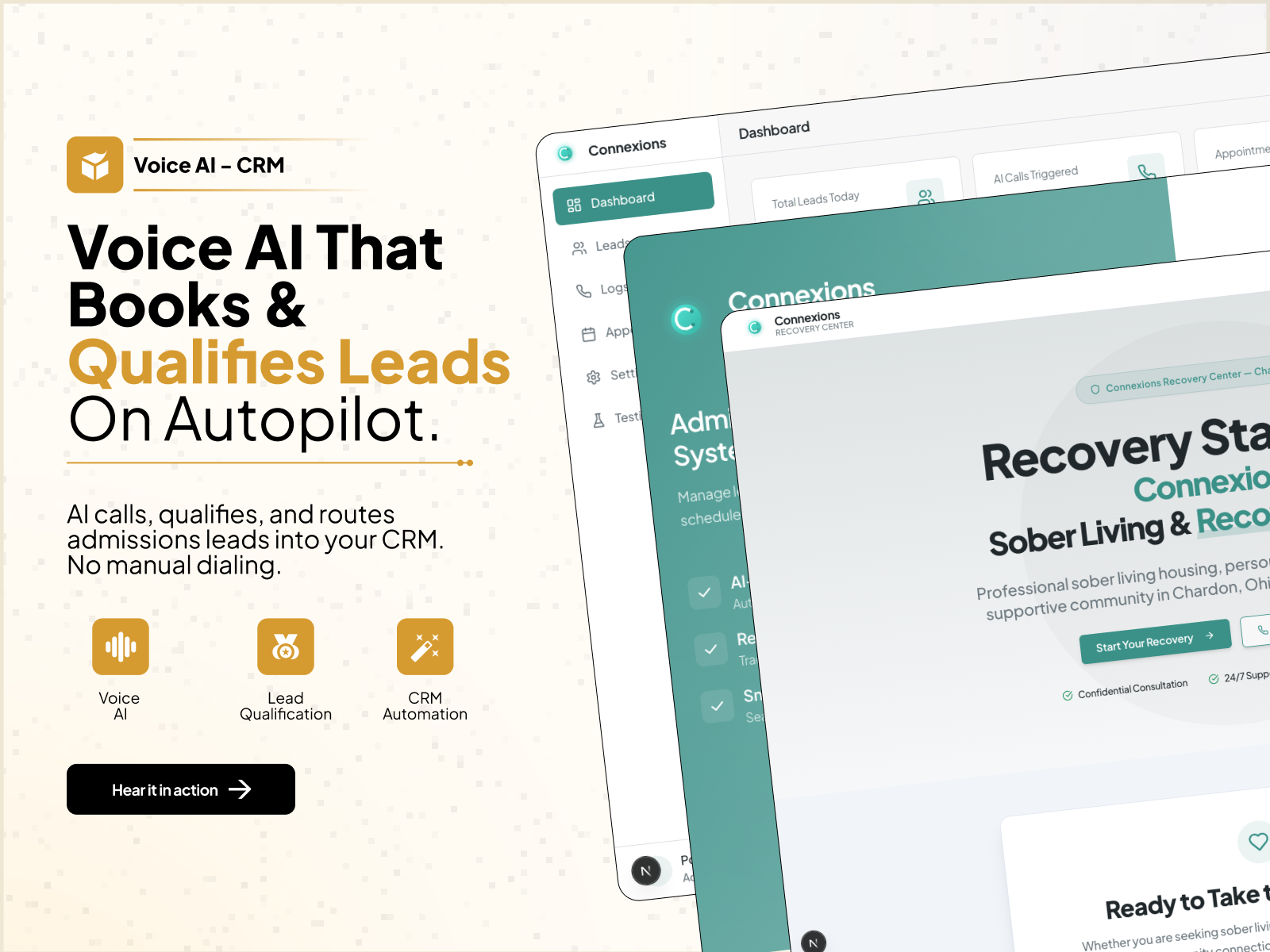
A recovery-admissions workflow that connects intake, voice calls, communication history, and staff follow-up.
Built for: Behavioral health admissions team
- call records
- 150+
- call records
- admissions leads
- 28+
- admissions leads
- communication paths
- 4
- communication paths
First agent live in one week. A short call. Your first agent, a fixed quote, and the timeline. No obligation.
Sound familiar?
- “Callbacks start from a phone number, so callers repeat their story every time.”
- “Calls, texts, and emails about the same person live in separate places.”
- “Staff cannot see what happened on the last call before picking up the next one.”
How the system works.
- Step 1
An AI voice intake line
Twilio calls connect to an OpenAI Realtime audio bridge with centralized instructions and tool calling for operational actions.
- Step 2
A lead record behind every call
Leads and call logs are stored in Supabase with the transcript, appointment context, SMS history, and email history attached.
- Step 3
Follow-up that does not get lost
Queued work and reminder scheduling keep the next contact moving, with Twilio for calls and SMS and Resend for email.
- Step 4
A review surface for staff
Dashboards show admissions activity so the next person continues the conversation instead of restarting it.
- Step 5
Clear limits on the assistant
The voice workflow handles intake and coordination. Clinical judgment stays with qualified staff.
What changed.
- 150+ call records connected to one reviewable admissions flow
- 28+ admissions leads tracked from first conversation to follow-up
- 3 channels, phone, SMS, and email, on the same lead record
- The phone-number-only handoff replaced with a full, reviewable history
The AI inside.
OpenAI Realtime
Holds the live voice conversation on inbound admissions calls and calls operational tools
OpenAI Whisper
Transcribes recorded calls so staff can review exactly what was said
The full stack.
Frontend
- Next.js 15
- React
- Tailwind CSS
- shadcn/ui
- Radix
- TanStack
- Recharts
Backend
- Node.js
- WebSockets
- Follow-up queues
- Reminder scheduling
Data
- Supabase
- Supabase Auth
AI and automation
- OpenAI Realtime
- OpenAI Whisper
Integrations
- Twilio voice and SMS
- Resend email
This fits you if...
- Your intake team handles repeat calls about the same person
- Callers have to repeat themselves because the last conversation was not captured
- Phone, text, and email follow-up are tracked in different tools
Start with a free Agent Audit. First agent live in one week
We build AI CRM systems like this.
A sales system built around how your team actually sells, with AI doing the follow-up work.
Full project write-upRead itClose
Project overview
Admissions calls with a record the staff can act on
Services: AI Receptionists ; AI Agents ; AI Workflow Automation ; AI ERP & CRM
Delivery: Voice intake, communications, and admissions CRM.
Project Snapshot
| Figure | What it represents |
|---|---|
| 150+ call records | Historical portfolio snapshot |
| 28+ admissions leads | Historical portfolio snapshot |
| 3 communication channels | Phone, SMS, and email in the workflow |
Call records do not mean 150 admissions. Lead counts do not establish a conversion increase.
The Problem
An admissions inquiry can involve several conversations before the staff has what it needs to proceed. A callback is harder when the next person only has a phone number and has to ask the caller to repeat the earlier conversation.
The project connected voice intake to lead records, transcripts, appointments, and follow-up. Admissions staff needed to see the history behind the inquiry, including contact through other channels.
What We Delivered
The voice service connects Twilio calls to an OpenAI Realtime audio bridge. Centralized instructions define the conversation, and tool-calling support connects it to operational actions.
The staff application stores leads and call logs in Supabase. It presents transcripts, appointment context, SMS history, and email history so the next person can continue with the available information.
Follow-up services handle queued work and reminders. Twilio supplies calling and SMS, while Resend handles email. Whisper supports transcription in the recorded-call path.
The frontend includes staff dashboards, authentication, and the views needed to review admissions activity.
Engineering Decisions
Separate the conversation from the record. The audio bridge has different responsibilities from lead storage, call logging, scheduling, and message delivery. Dedicated services handle each part.
Keep the next contact attached to the inquiry. Calls, messages, and follow-up work need shared lead context rather than independent contact lists.
Give staff a review surface. A transcript and communication history let staff inspect the interaction before continuing it.
Limit the assistant's role. The voice workflow supports intake and coordination. Clinical judgment remains with qualified staff.
Results
The existing portfolio snapshot includes 150+ call records and 28+ admissions leads in the connected system.
The delivered workflow gives staff a path from the first conversation to the lead record and subsequent contact. It replaces the phone-number-only handoff with a reviewable history. Admissions growth and response-time improvements have not been quantified in the available records.
Technology stack
Next.js 15, React, Tailwind CSS, shadcn/ui, Radix, TanStack tooling, Recharts; Node.js and WebSockets; Supabase and Supabase Auth; Twilio; OpenAI Realtime and Whisper; Resend; follow-up queues and reminder scheduling.
Related case studies.
Sun Speed CRM
A voice agent that qualifies solar leads and books the visit
AI: OpenAI Realtime, Vector search
Closeum
One system from the sales call to the commission
AI: OpenAI, Recall.ai
HubSpot MCP
Every HubSpot deal reviewed and given a clear next step
AI: Model Context Protocol (MCP), AI account synthesis and drafting
Want this for your team?
Book a short audit call and show us the workflow. You leave with the first agent we would build, a fixed quote, and the timeline.