Zehaanat, Education
Articles and ePaper pages turned into study material and practice
A learning product that carries source intake through revision, practice, and essay feedback.
Built for: Candidates preparing for the CSS and MPT examinations, on web and an Android-first mobile app.
- spaced review intervals
- 4
- spaced review intervals
- platforms: web and Android
- 2
- platforms: web and Android
- text and vision extraction
- GPT-5 nano
- text and vision extraction
First agent live in one week. A short call. Your first agent, a fixed quote, and the timeline. No obligation.
Sound familiar?
- “I read the news every day, but the useful facts never make it into my revision.”
- “Half my sources are ePaper page images that normal tools can't read.”
- “I write practice essays with nobody to tell me what's wrong with them.”
How the system works.
- Step 1
Two source paths
Text articles are fetched server-side; ePaper screenshots go through vision-based extraction, because one method can't handle both well.
- Step 2
AI study extraction
GPT-5 nano turns the material into study-oriented content that lands in a tagged factbook organized by subject and theme.
- Step 3
Built-in revision
Every saved fact gets a 2-3-5-7 day spaced-review schedule instead of sitting in a notes file.
- Step 4
Practice and essays
MPT drills, timed mocks, accuracy history, PEEL outlines, heuristic checks, AI essay feedback, and optional RAG search over past papers.
- Step 5
Controlled AI costs
Per-account request ceilings and a usage ledger record tokens, latency, failures, and estimated cost, without storing study content.
What changed.
- One product connects source intake, extraction, revision, practice, and essay writing.
- 2 source paths, 2 grading paths, and a 2-3-5-7 review schedule in production.
- Administrators see exactly what the AI features cost, per account.
- Desktop and mobile covered by Playwright tests, with shared API contracts across web and mobile.
The AI inside.
GPT-5 nano
Text and vision extraction from articles and ePaper pages, plus essay feedback
OpenRouter
Model routing for AI requests
OpenAI
Model provider for extraction and feedback
RAG search
Optional answers grounded in past examination papers
The full stack.
Frontend
- Next.js
- React Native
- Shared API contracts
Backend
- Cheerio article fetching
- Account-level AI limits
- Usage reporting
Data
- MongoDB
AI and automation
- GPT-5 nano
- OpenRouter
- OpenAI
- Optional RAG
Infrastructure
- Playwright testing
This fits you if...
- You need to pull useful information out of both text and image-based documents.
- You want AI features with clear per-user cost controls.
- Your product should turn raw reading into structured, reusable records.
Start with a free Agent Audit. First agent live in one week
The Document Intake Agent brings this to your team.
Every contract, invoice, and bid pack becomes a checked record, with the source page attached.
Full project write-upRead itClose
Project overview
Current-affairs reading that carries into revision and essay practice
Services: Document AI ; AI Workflow Automation ; RAG Knowledge Systems
Delivery: CSS/MPT preparation product across web and Android-first mobile.
Project Scope
| Detail | Product behavior |
|---|---|
| 2 source paths | Text articles and image-based ePaper material |
| 2-3-5-7 sequence | Factbook spaced-review schedule |
| 2 grading paths | Heuristic checks and AI essay feedback |
| Per-account request ceiling | Configurable control over AI usage |
These are implemented product details, not measured learning gains.
The Problem
CSS preparation involves reading current affairs, selecting useful facts, connecting them to subjects, revising them, and using them in written answers.
The source material creates another difficulty. Ordinary articles contain fetchable text; ePaper pages can be images with page layout. The same extraction method does not handle both well.
What We Delivered
Zehaanat fetches text articles server-side and accepts ePaper screenshots for vision-based extraction. GPT-5 nano turns the material into study-oriented content. A tagged factbook organizes it by subject and theme, then schedules repeated review.
The workspace also includes MPT drills, timed mocks, saved accuracy history, subject selection with official group constraints, study planning, and recovery scheduling.
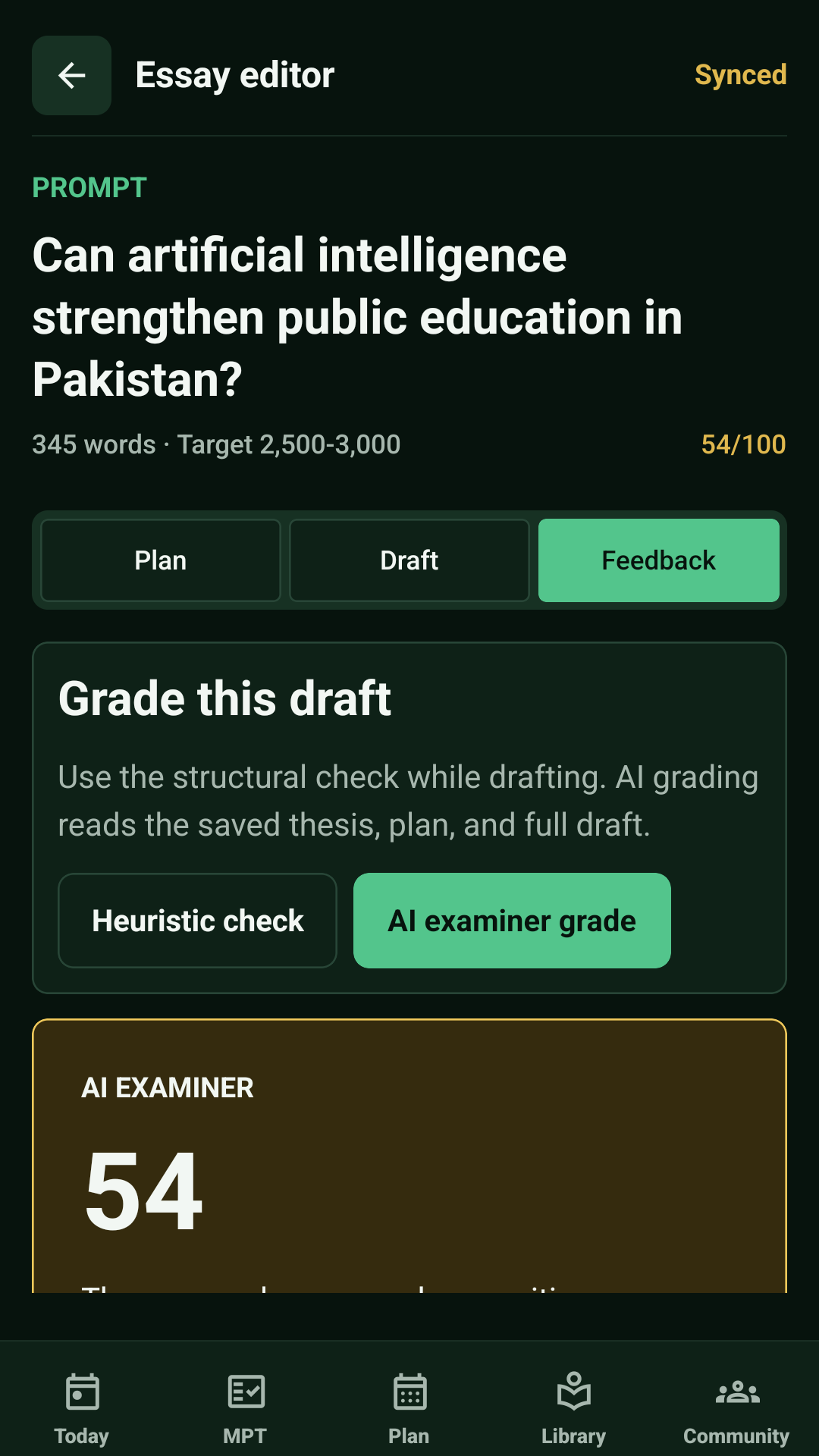
Essay tools support PEEL outlines, drafts, heuristic checks, and AI feedback. Past-paper search has an optional RAG answering path. The Android-first React Native app shares API contracts with the web product.
Administrators manage access periods, module permissions, manual payments, and AI usage.
Engineering Decisions
Handle page images separately from article text. Cheerio-based fetching prepares text sources; screenshot input supplies image-based material to the vision workflow.
Make revision part of the record. A saved fact has subject/theme context and a review schedule rather than remaining an isolated note.
Measure model use at the account level. The usage ledger records tokens, latency, failures, and estimated cost without retaining prompts or study content in that ledger.
Keep payment behavior explicit. Payments are verified outside the app, then recorded by an administrator to activate or renew access.
Results
The delivered product connects source intake, study extraction, revision, practice, and writing. It also exposes the operational cost of its AI features to the administrator.
The repository documents desktop/mobile Playwright coverage and shared contracts for mobile. No pass-rate, student-count, or official examiner endorsement is claimed.
Technology stack
Next.js, MongoDB; OpenRouter and OpenAI; GPT-5 nano text/vision extraction and essay feedback; Cheerio; React Native and shared API contracts; Playwright; account-level AI limits and usage reporting.
Product Image

Existing product screenshot. The displayed score is example AI feedback, not an official exam mark.
Related case studies.
Planroom
Bid packages turned into answers with the source page attached
AI: OpenAI Responses API, LangGraph, Pinecone
BookSmart
Invoices, bank statements, and SIE files read into the books
AI: OpenAI GPT-4o, Tesseract OCR, AWS Textract
LetterMate
Twenty guided workflows that turn facts into formal letters
AI: OpenAI GPT-4.1
Want this for your team?
Book a short audit call and show us the workflow. You leave with the first agent we would build, a fixed quote, and the timeline.