Fieldline, Construction
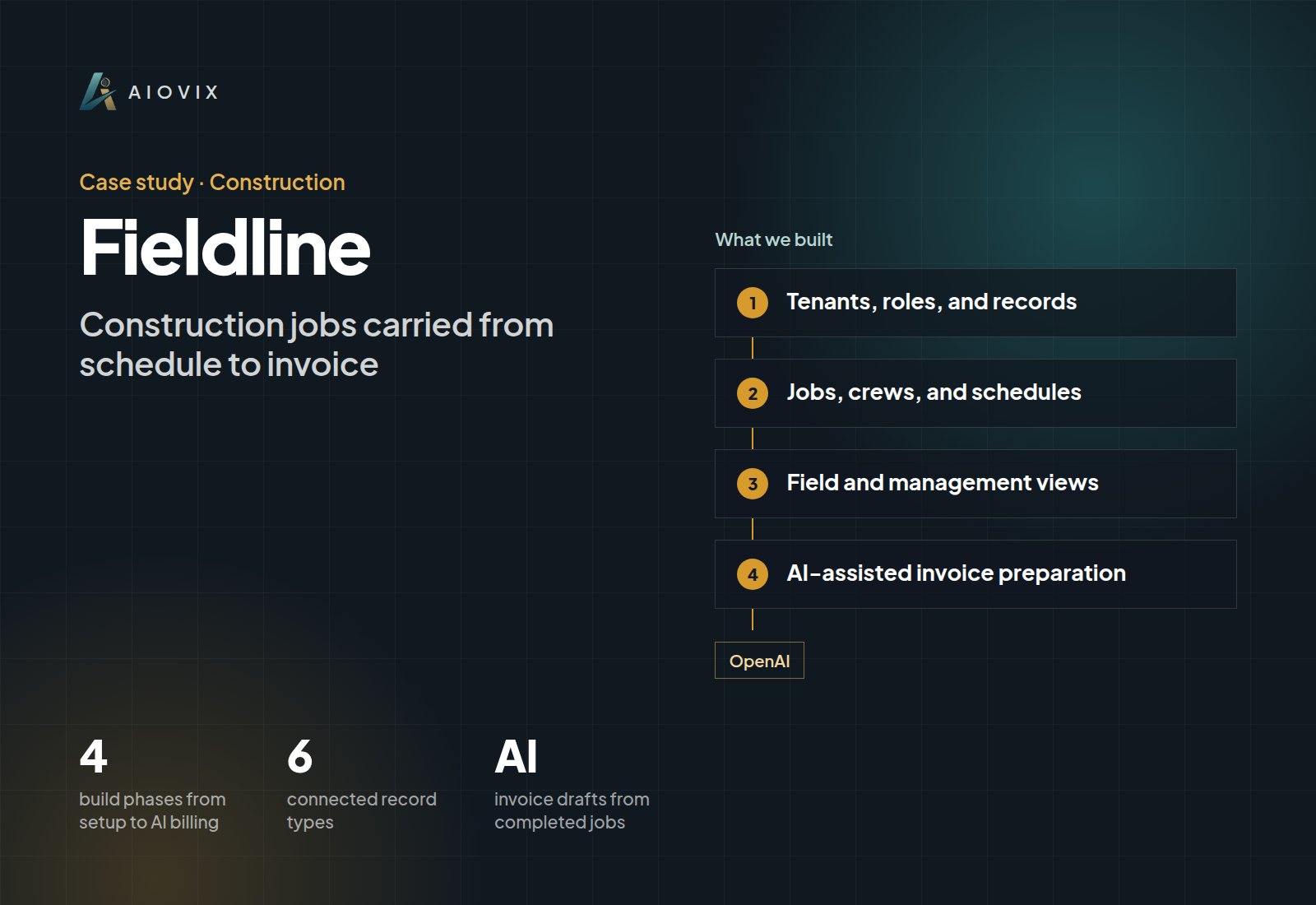
Construction jobs carried from schedule to invoice
A multi-tenant construction platform that was later extended into AI-assisted billing.
Built for: Construction operator with office staff and field crews
- build phases from setup to AI billing
- 4
- build phases from setup to AI billing
- connected record types
- 6
- connected record types
- invoice drafts from completed jobs
- AI
- invoice drafts from completed jobs
First agent live in one week. A short call. Your first agent, a fixed quote, and the timeline. No obligation.
Sound familiar?
- “Estimates are on paper, schedules are in spreadsheets, and billing is manual.”
- “The same job gets retyped for scheduling, management, and invoicing.”
- “Office staff reconstruct completed work before they can send an invoice.”
How the system works.
- Step 1
Tenants, roles, and records
A multi-tenant structure with customer and vendor records and role-based access.
- Step 2
Jobs, crews, and schedules
Jobs connect to crews and schedules so the office and the field share one record.
- Step 3
Field and management views
Working views for field operations and dashboards for management.
- Step 4
AI-assisted invoice preparation
OpenAI drafts invoice content from completed-job data already in the platform, with approval and issuing kept as separate steps.
What changed.
- Field operations, scheduling, and billing in one product
- Invoices prepared from recorded job data instead of reconstructed from memory
- AI billing built on the same job record, without a separate tool
- Approval, issuing, and collection kept as clear, separate business actions
The AI inside.
OpenAI
Drafts invoice content from completed-job records for office review
The full stack.
Frontend
- Next.js
Backend
- Node.js
- Multi-tenant architecture
Data
- PostgreSQL
AI and automation
- OpenAI
Integrations
- Stripe
This fits you if...
- Your office rebuilds job details by hand before every invoice
- Crews, schedules, and billing live in different tools
- You want AI help with invoicing that works from real job data
Start with a free Agent Audit. First agent live in one week
The Finance Operations Agent brings this to your team.
Close the month in days and get paid on time.
Full project write-upRead itClose
Project overview
Construction jobs carried through to invoice preparation
Services: AI ERP & CRM ; AI Workflow Automation ; AI Fintech
Delivery: Multi-tenant construction operating platform, followed by an AI billing extension. Portfolio alias.
The Problem
The construction operation used paper estimates, spreadsheet schedules, and manual billing split between crews and office staff, according to the original project brief.
The same job had to be interpreted more than once: first to schedule it, then to manage it, and later to invoice it. The client needed shared records that matched the movement of work between the office and the field.
What We Delivered
The initial platform covered customer and vendor records, jobs, crews, roles, scheduling, field operations, and management dashboards.
The later billing extension used completed-job data for AI-assisted invoice preparation. Because the job records were already in the product, the extension could use operational context rather than asking office staff to reconstruct it in a separate tool.
Delivery Sequence
- Establish the tenant, role, and record structure.
- Connect jobs, crews, and schedules.
- Add working views for field operations and management.
- Extend the same product into AI-assisted billing.
The operating platform came first; AI-assisted billing extended the shared job record.
Engineering Decisions
Keep a job identifiable across departments. Scheduling and billing must refer to the same operational record.
Build the AI extension on recorded work. The invoicing layer uses completed-job information rather than a free-form request without source context.
Retain separate business actions. Preparing invoice content is different from approving charges, issuing the invoice, or collecting payment.
Results
The delivered platform puts field operations and billing in one product. The later AI extension reused the initial job-management foundation.
The project record supports this delivery progression. It does not provide an invoice-volume count, billing-time baseline, or reduction in collection delay, so no financial lift is invented.
Technology stack
Documented stack: Next.js, Node.js, PostgreSQL, Stripe, OpenAI, multi-tenant application architecture.
Example value calculation
Hypothetical planning example, not a measured project result or a performance forecast. All volumes and timings below are assumed.
Recover completed-job details, prepare the invoice, and check the proposed charges.
- Workload: 100 completed-job invoice preparations per month.
- Manual handling: 12 minutes per item.
- Assisted handling, including human review: 5 minutes per item.
- Additional exception handling: 60 minutes in the same period.
- Modeled difference: 100 x (12 - 5) - 60 = 640 minutes (10 hours 40 minutes) per month.
The example reserves another 60 minutes per month for missing field records and billing corrections. Approval, issuance, and collection remain separate steps. This is potential staff capacity, not cash savings; setup, training, and software costs are excluded.
How to validate: Measure from an invoice-ready job record to an approved invoice draft. Include manual corrections and missing-data follow-up; track completion-to-issuance delay separately.
Related case studies.
Want this for your team?
Book a short audit call and show us the workflow. You leave with the first agent we would build, a fixed quote, and the timeline.